Roof Replacement in Scottsdale
Roof replacement in Scottsdale is a decision, not just a job: the signs your roof is done, the repair-vs-replace test, what a full replacement involves, and the best time of year to do it.
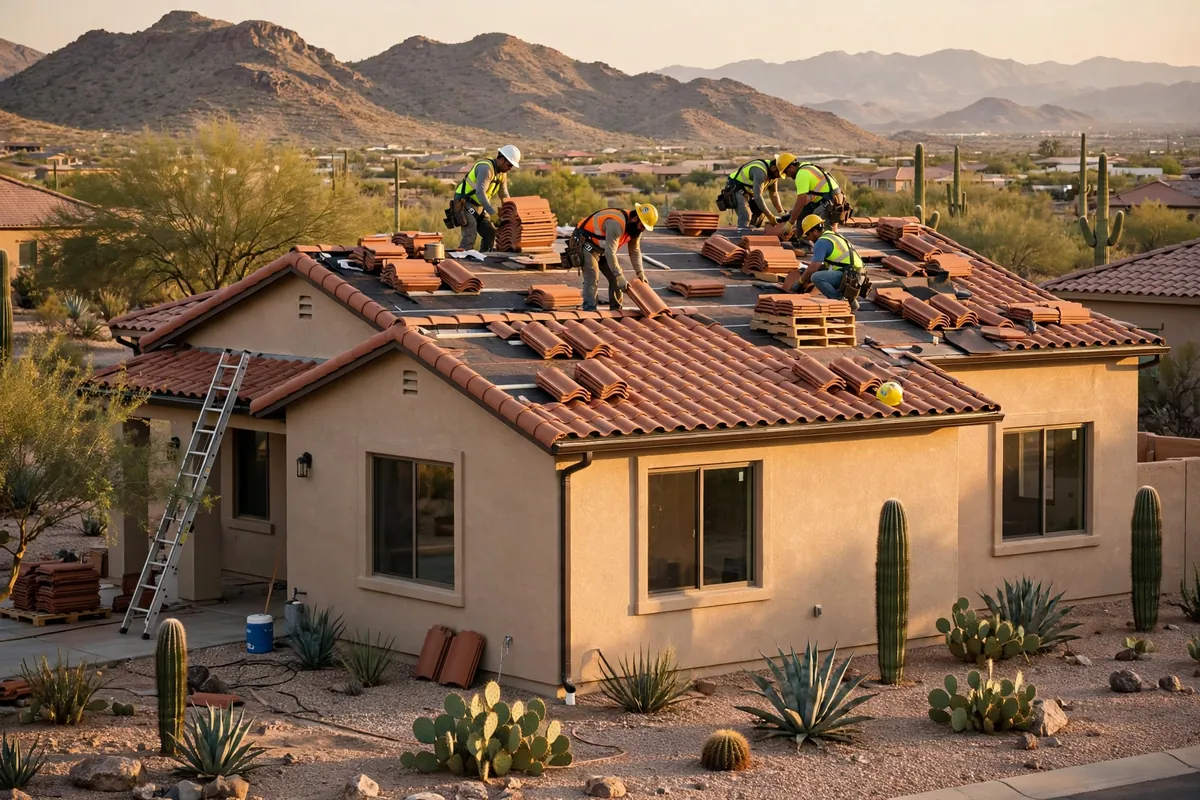
· Roof Repairs Scottsdale
Every roof in Scottsdale has two clocks running, and they do not run at the same speed. The first clock is the one in the brochure — the number of years a roof is expected to last. The second clock is the desert itself: the sun that bakes the surface every summer afternoon, the monsoon rain that arrives in heavy bursts, the dust that works its way into every joint. In Scottsdale, the second clock almost always runs faster, which is why the question most homeowners eventually ask is not whether their roof will need replacing, but when — and how to tell the difference between a roof that needs one more repair and a roof that is done.
This guide answers that question the way a roofer would answer it on your driveway: the signs that a roof is near the end, the simple test that separates a repair from a replacement, what a full roof replacement in Scottsdale actually involves step by step, and the best time of year to do it. If your roof is leaking in more than one place, if the repairs keep coming back, or if the roof is simply old and tired, this is the guide to read before you spend another dollar patching it.
Why a Scottsdale roof ages faster than the brochure says
A roof in Scottsdale does not age the way the same roof would age in a mild climate, and the reason is the weather it lives under. From May through September the roof surface regularly gets far hotter than the air temperature — dark shingles and tile on a south- or west-facing slope can be hot enough to soften asphalt and dry out sealants. Then the desert night cools it down fast, and the next day heats it up again. That daily expansion and contraction pulls at every seam, every nail and every flashing a little more with each cycle, year after year.
Then comes the monsoon. From mid-June through September, storms drop heavy rain in short bursts, often with wind that drives the rain sideways under tiles and shingles. A roof that was fine in a light winter rain can leak in a monsoon downpour, because the water is arriving faster and from an angle the roof was not shedding. Winter storms are different — steadier, longer rain that soaks a weak seam or a tired underlayment for hours. And between the storms, dust and wind push grit into the valleys, the gutters and the joints, where it holds moisture against the surface long after the rain has stopped.
Put those three forces together — heat, hard rain and dust — and the pattern of a Scottsdale roof at the end of its life becomes predictable. The surface material dries out and cracks, the layer underneath it wears thin, the flashing loosens, and the leaks start in more than one place. Our guide on how long a roof lasts in Scottsdale gives the expected life of each roof type in this climate, and the numbers there are the starting point for the decision in this guide — but age alone never decides it. Two roofs of the same age can be in very different shape, depending on sun exposure, installation quality and how they were looked after.
The signs your roof is near the end
A roof rarely fails without warning. It tells you, first in small ways and then in ways that are hard to ignore. The signs below are the ones that matter most in Scottsdale, and they fall into three groups: what you can see from the ground, what you notice inside the house, and what the roof's age tells you. One sign on its own is usually a repair. Several of them together, on a roof that is already old, is the conversation this guide is about.
What you can see from the ground
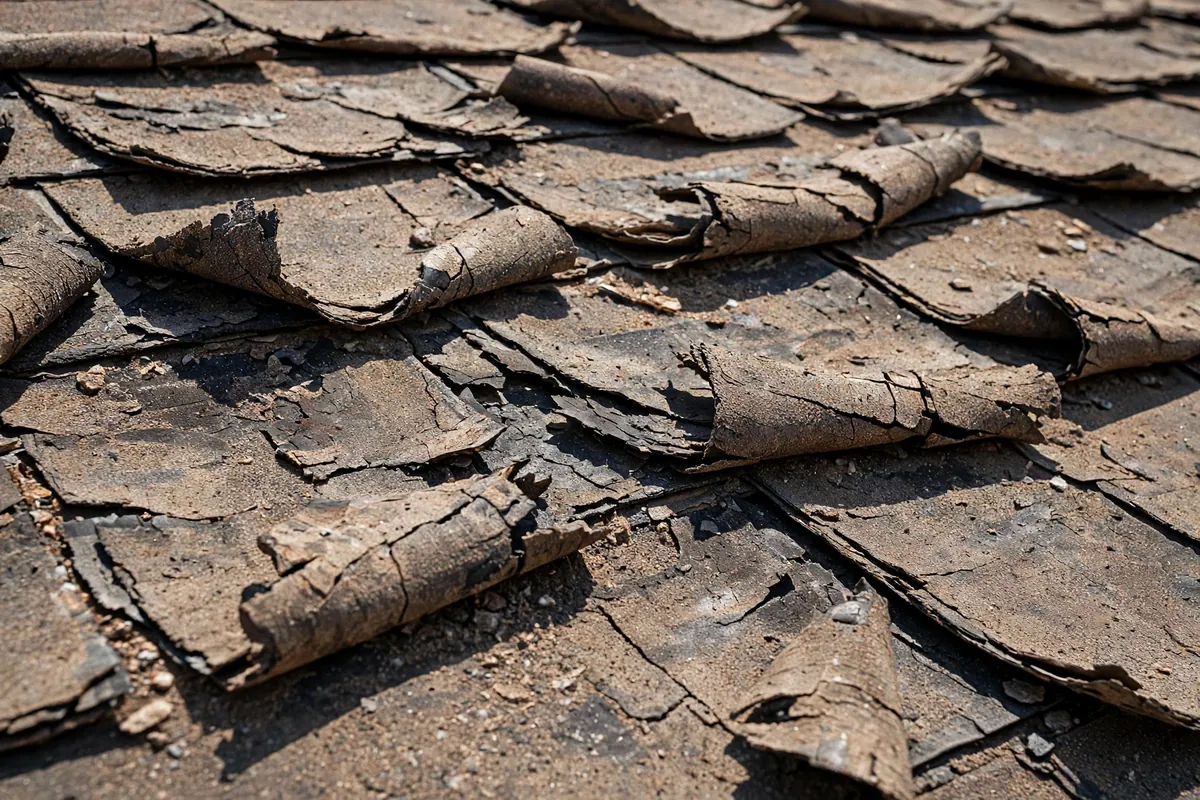
Start with the shingles, if your roof has them. Shingles that are curling upward at the edges, cracking down the middle, blistering, or missing entirely have had their protective layer worn away by the sun. A few damaged shingles after a storm are a repair. Shingles curling or cracking across whole slopes, on more than one side of the house, mean the material itself is giving up. Look at the gutters and downspouts too: shingles shed small granules as they age, and a gutter full of grit, or granules piling up where the downspout meets the ground, is one of the clearest signs that a shingle roof is near the end of its life.
On a tile roof, the signs look different. Cracked, slipped or missing tiles, especially after wind or a monsoon storm, are the visible part — but the more important sign is what you cannot see from the street. The tiles on a Scottsdale roof can last fifty years or more, while the underlayment beneath them, the layer that actually keeps the water out, usually lasts twenty to twenty-five years. A tile roof can look perfect from the kerb while its underlayment is quietly worn out, which is why a tile roof that is leaking is often an underlayment problem rather than a tile problem. Our guide to tile roof repair in Scottsdale explains that two-clock problem in detail.
Two more things to look for from the ground: a roofline that sags or dips anywhere, which can mean the decking or the framing underneath has weakened and should never wait, and a roof that has faded badly or changed colour across large areas, which is the sun's work over many summers. A sagging roofline is the one sign on this list that is urgent on its own — call before the next storm, not after it.
What you notice inside the house
Your ceilings often report a failing roof before the roof shows it. Water stains on a ceiling or a wall are the classic sign, and on a tile roof they usually point to the underlayment. A stain that keeps coming back in the same place after a repair, or stains appearing in different rooms after different storms, mean the problem is no longer local — water is getting in at more than one point. A damp or musty smell in a room or in the attic after rain, sagging or drooping ceiling sections, and wet insulation in the attic all point the same way.
Two quieter signs are easy to miss. The first is daylight showing through the roof deck when you look up in the attic with the lights off — if light gets in, water gets in. The second is a cooling bill that keeps climbing for no clear reason. A roof that has lost its reflective coating, or whose ventilation has failed, lets more heat into the attic, and the air conditioning works harder to keep up. Neither sign on its own proves the roof needs replacing, but either one, on a roof that is already showing wear outside, is worth an honest look.
And then there is the pattern of the repairs themselves. One repair call in five years is normal roof ownership. Three repair calls in two years, each for a different leak, is a pattern — and it is the pattern that most often means the roof is done. Each patch is laid on material that is already tired, and the next storm finds the next weak spot. At some point the repairs stop being the cheaper option, and that point usually arrives sooner than homeowners expect.
The age test
Age is the third group of signs, and it is the one that frames all the others. A shingle roof in Scottsdale that is fifteen to twenty years old and showing widespread wear is a different conversation from a shingle roof that is eight years old with one cracked shingle. A tile roof whose underlayment is twenty-five years old is a different conversation from a tile roof whose underlayment was replaced ten years ago. A foam roof that has had its coating renewed on schedule can keep going; one that has not is a different story, and our guide to flat roof repair in Scottsdale covers when a recoat is enough and when it is not.
If you do not know how old your roof is, your home's build date or the last permit on file gives you a solid estimate. If the house changed hands, the inspection report from the sale often lists the roof's age and material. And if none of that is to hand, the condition of the roof itself tells the story — a roofer who walks the roof and the attic can read the age in the wear, even without the paperwork.
Repair or replace? The three-question test
Every roof replacement decision comes down to three questions, and they are the same three questions a roofer asks on every inspection. First, how widespread is the damage? A repair makes sense when the problem is local — a few slipped tiles, one bad seam, one leak, one slope. Replacement enters the conversation when the damage is widespread: shingles failing across multiple slopes, leaks in different spots after different storms, a membrane or underlayment that has failed in more than one place, or a deck that is soft underfoot in several areas.
Second, how old is the roof, and how much life does it have left? A repair on a roof with fifteen years left in it is a good investment. The same repair on a roof with two years left in it is money spent twice — once on the patch, and again on the replacement that follows soon after. That is why the age and lifespan numbers matter, and why an honest inspection looks at the roof's remaining life, not just today's leak. If you want to understand what drives the scope of a job before you talk to anyone, our guide to roof repair cost in Scottsdale explains the factors that shape any roofing job here — size, material, access and damage.
Third, what is underneath the surface? The surface is only half the roof. The underlayment, the flashing and the decking decide whether a repair will hold. If the underlayment is worn out, patching the tiles above it will not stop the leaks. If the decking is soft or water-damaged, a new surface laid on top of it will not last. The only way to answer this question properly is an inspection that looks at the roof from the attic as well as from above — which is why a roof inspection is the right first step whenever the repair-or-replace question comes up, not a guess from the ground.
There is one special case that confuses Scottsdale homeowners more than any other: the tile roof that looks fine but leaks. The answer is usually an underlayment replacement, not a full replacement — the tiles come off, are stacked, a new underlayment goes down, and the same tiles go back on. It is the most common large roofing job in Scottsdale, and it costs less than a full re-roof because the tiles themselves are reused. A full roof replacement is the answer when the tiles themselves are failing, the decking is damaged, or the roof is changing material — for example from shingle to tile, or from an old flat system to a new one.
What a roof replacement involves, step by step
A roof replacement is a bigger job than a repair, but it follows a fixed order, and knowing that order takes most of the worry out of it. It starts with the inspection and the measurements — a walk of the roof and the attic, a check of the ventilation, the flashing, the penetrations and the decking, and a written scope that explains what will be done in plain language. This is also the point where permits and HOA rules are sorted out: most Scottsdale neighbourhoods have architectural standards for tile colour and profile, and some HOAs ask for a submittal before work begins.
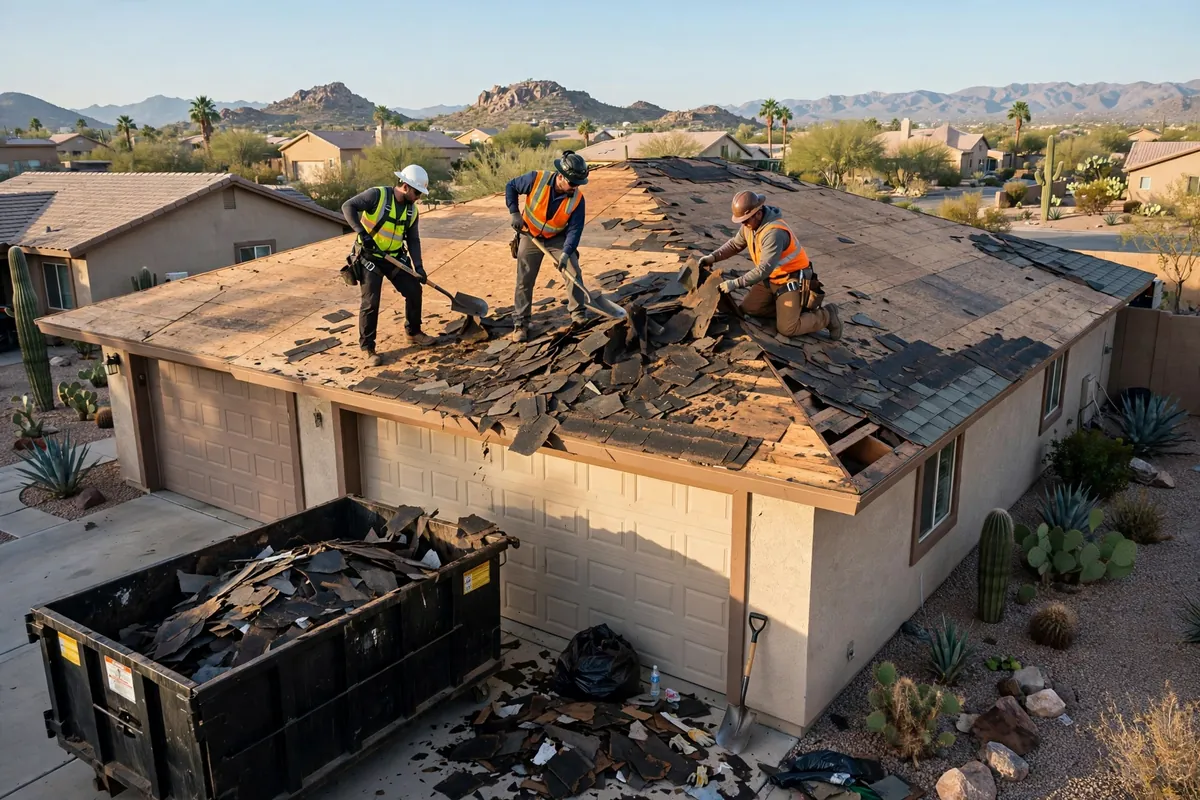
Then comes the tear-off. The old roofing material comes off down to the wood deck, and the debris is taken away — usually into a skip or a truck the same day, with landscaping, pool areas and air conditioning units covered before the work starts. A tear-off is the only way to see what is underneath, and it is the step that separates a proper replacement from a cover-up: laying a new roof over an old one hides the decking, the underlayment and the flashing, so nobody can tell whether they are sound.
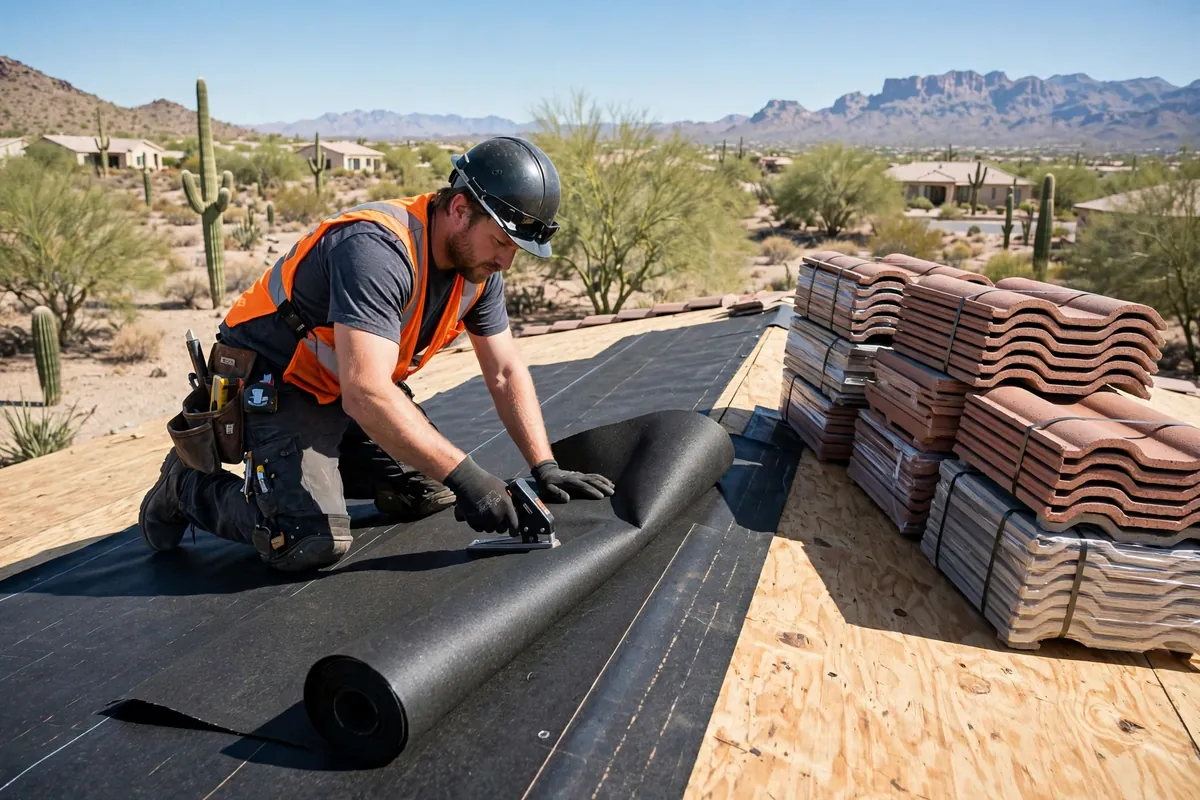
With the deck bare, the crew inspects it board by board. Delaminated or water-softened sheathing is replaced so the new roof has a solid, flat base — this is the step where the surprises, if there are any, are found and fixed, rather than covered over. Then the new underlayment goes down, the flashing is rebuilt around vents, chimneys, skylights and valleys, and the ventilation is put right, because a new roof on a poorly ventilated attic will age faster than it should.
Only then does the new material go on — tile, shingle, metal or foam, fastened to the manufacturer's pattern for a high-wind area, with starter strips at the eaves and matching hip and ridge caps. The job closes with a cleanup and a final walkthrough: the yard is cleared, the gutters are checked, and the roof is looked over with the homeowner so that anything that needs attention is caught while the crew is still there. A full replacement on a typical Scottsdale home usually takes one to three days, depending on size and weather; large tile roofs, where every tile is lifted, stacked and relaid, take longer.
Tile, shingle, metal or foam: choosing the next roof
A replacement is also the one moment when the material can change, so it is worth choosing with the desert in mind rather than by habit. Tile is Scottsdale's dominant material for a reason: clay and concrete tile hold up to desert heat far longer than shingle, they suit the architecture of the city, and they are what most HOAs expect to see. Their weakness is weight and the underlayment beneath them — the tiles outlast the waterproofing layer, so plan for an underlayment replacement once in the roof's life.
Architectural shingles are the more affordable option and a good fit for homes where the roof structure cannot carry tile, or where the homeowner wants a simpler profile. In Scottsdale heat they give roughly fifteen to twenty years, shorter than in a mild climate, and they need their granules intact to do their job — which is why the granule check in the gutters matters so much. Metal roofing, usually standing seam, lasts decades, sheds heat well and stands up to wind, and suits modern and contemporary homes; its trade-off is a higher upfront cost and a look that does not suit every neighbourhood. Foam, for flat sections, additions and casitas, works well when its coating is renewed on schedule — and fails fast when it is not.
The right choice is the one that fits three things at once: the house and its structure, the neighbourhood and its HOA rules, and the climate. A roofer who knows Scottsdale will talk through all three before recommending a material, because a roof that fights its own neighbourhood or its own structure is a roof that will cause trouble later.
The best time of year to replace a roof in Scottsdale
Timing matters more in Scottsdale than in most cities, because the weather sets the working conditions. The best window is autumn through spring, roughly October to May. The weather is mild, the crews can work full days, and the materials behave — shingles seal properly, coatings and adhesives cure within their temperature limits, and there is no monsoon storm building in the afternoon. If your roof needs to be sound before the monsoon, spring is the time to book.
Summer replacements are possible, but they take longer: crews start at first light and stop by early afternoon, shingles get soft and scuff easily when hot, and a job that would take two days in November can take three or four in July. Winter, by contrast, is prime roofing season here — mild, dry, with no snow to work around. The one timing rule that matters most is the rain plan: a good crew watches the forecast, opens only as much roof as can be made watertight the same day, and covers the roof if a storm builds. That matters most from mid-June through September, when a monsoon cell can arrive in an afternoon.
There is also a timing argument for replacing on your own schedule rather than in an emergency. A replacement planned in the cooler months, after an inspection and with the HOA approval already in hand, is calmer and cheaper in every sense than a replacement forced by a leak that has damaged ceilings and insulation. The roof does not care about your calendar — but your calendar is the best tool you have for getting the job done well.
What to check before you call
A few minutes of looking before you call makes the inspection faster and the advice better. Note how old the roof is, or your best guess from the house's build date. Note the material — tile, shingle, metal or foam — and whether the roof has had repairs before, and where. Take photos of what you can see from the ground: curling shingles, slipped tiles, granules in the gutters, a sagging line, and any stains inside the house, with a note of when each one appeared — after a monsoon burst, after a long winter rain, or slowly over a summer.
Also note the practical things: whether your HOA has rules about roof material or colour, whether there is access for a skip or a truck, and whether the roof has solar panels, an evaporative cooler or air conditioning units sitting on it, because each of those changes the job. A roofer who arrives with those facts can spend the visit reading the roof instead of hunting for the basics — and can give you a straight answer to the question that matters: repair, underlayment, or a full replacement.
The takeaway: replace on your schedule, not the roof's
A roof replacement in Scottsdale is a decision, not just a job — and the decision is simpler than it looks. If the damage is local, the roof is young, and the layers underneath are sound, repair it. If the damage is widespread, the roof is near the end of its expected life, or the underlayment and decking have had enough, replace it — and if the tiles are still good, ask about reusing them on a new underlayment. Do it in the cooler months if you can, before the monsoon rather than after it, and do it after an inspection that looks at the attic as well as the roof. If your roof is leaking in more than one place, if the repairs keep coming back, or if the granules in the gutter are telling you the shingles are done, call us at +1 (480) 907-0320 and we will walk the roof with you, tell you honestly whether it needs a repair or a replacement, and leave you a roof that is ready for the next desert summer.