How Long Does a Roof Last in Scottsdale?
How long does a roof last in Scottsdale? It depends on the material — and on the desert. Tile, shingle, foam and metal lifespans, what wears them out, and how to get more years from yours.
· Roof Repairs Scottsdale
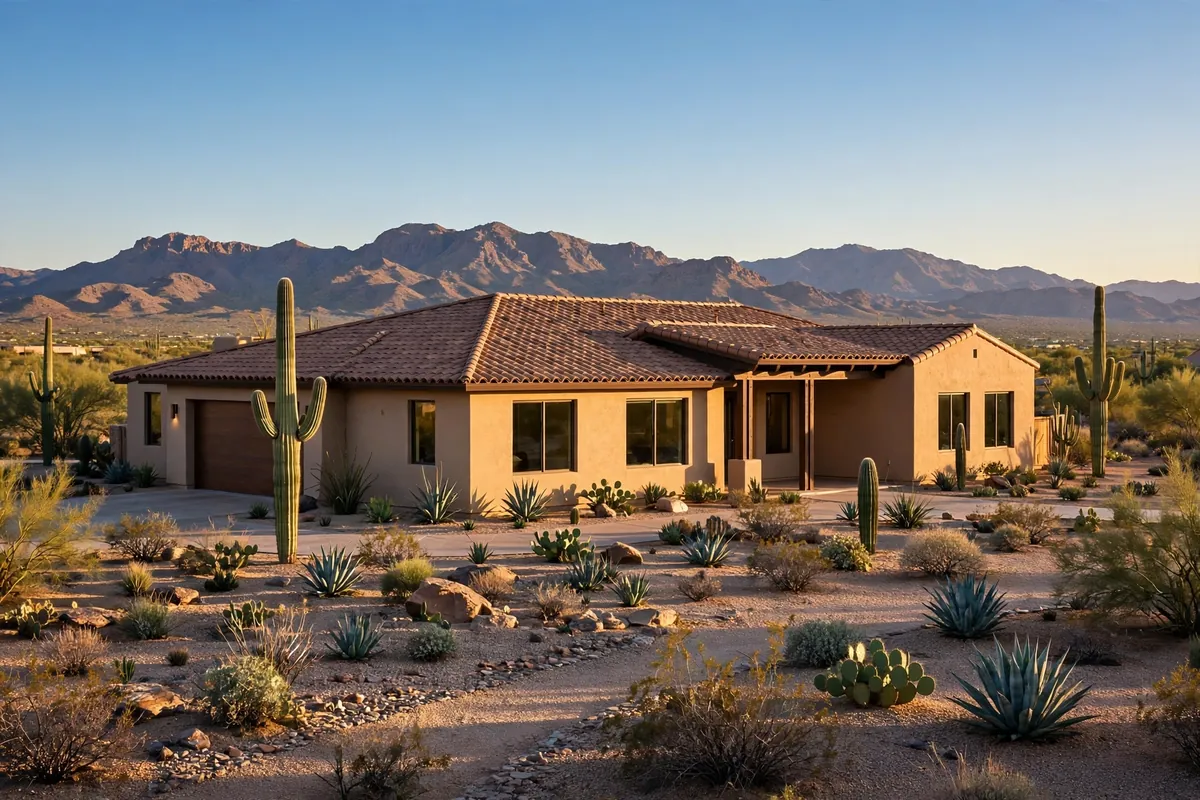
How long does a roof last in Scottsdale? It is the first question most homeowners ask when they start thinking about their roof — and the honest answer is that it depends on what the roof is made of, how it was put on, and how it has been looked after. In Scottsdale, the same roof that might last 30 years somewhere milder can give up years earlier, because the desert works on a roof every single day: sun, heat, dust, and then a monsoon season that tests everything at once.
This guide gives you the straight answer by roof type — tile, shingle, foam and metal — with the lifespans roofers in Arizona actually see on real homes, not the best-case figures on a manufacturer's brochure. You will also find the signs that your roof is reaching the end of its life, and what you can do to get more years out of the roof you already have.
Why Scottsdale roofs age faster than most
Four forces shape every Scottsdale roof. The first is ultraviolet light. The sun here is strong for most of the year, and UV breaks down roofing materials steadily — it dries out sealants, makes shingles brittle, wears coatings thin, and ages the underlayment beneath tiles. The second is thermal cycling: the daily swing between hot afternoons and cool desert nights makes materials expand and contract, and over years of daily movement, joints, seams and fasteners work loose.
The third is monsoon weather, from 15 June to 30 September — heavy rain in short bursts, strong gusts, dust and sometimes hail — which tests every weak point at once. The fourth is dust: fine desert dust settles everywhere, holds moisture against surfaces, and collects in valleys, gutters and scuppers where it can block drainage. A roof in Scottsdale does not fail all at once. It wears down a little at a time, in the places where these four forces work hardest — which is why two roofs of the same age, on the same street, can be in very different shape.
How long does a roof last in Scottsdale?
Short answer first: a tile roof in Scottsdale can protect a home for 40 to 50 years or more, a shingle roof for 15 to 25 years, a foam roof for decades if its coating is renewed on schedule, and a metal roof for 40 to 70 years. But those numbers hide the detail that matters most — on a tile roof, the tile is not the part that wears out first. The layer underneath it does, and that changes the whole picture.
- Tile (clay or concrete): 40–50+ years for the tiles; underlayment 15–25 years
- Asphalt shingle: 15–25 years in desert heat
- Foam (flat roofs): decades, with a recoat every 5–10 years
- Metal: 40–70 years
The rest of this guide takes each one in turn — what lasts, what fails first, and what it looks like when the end is near. If you are trying to decide between repairing and replacing, the last two sections are the ones to read.
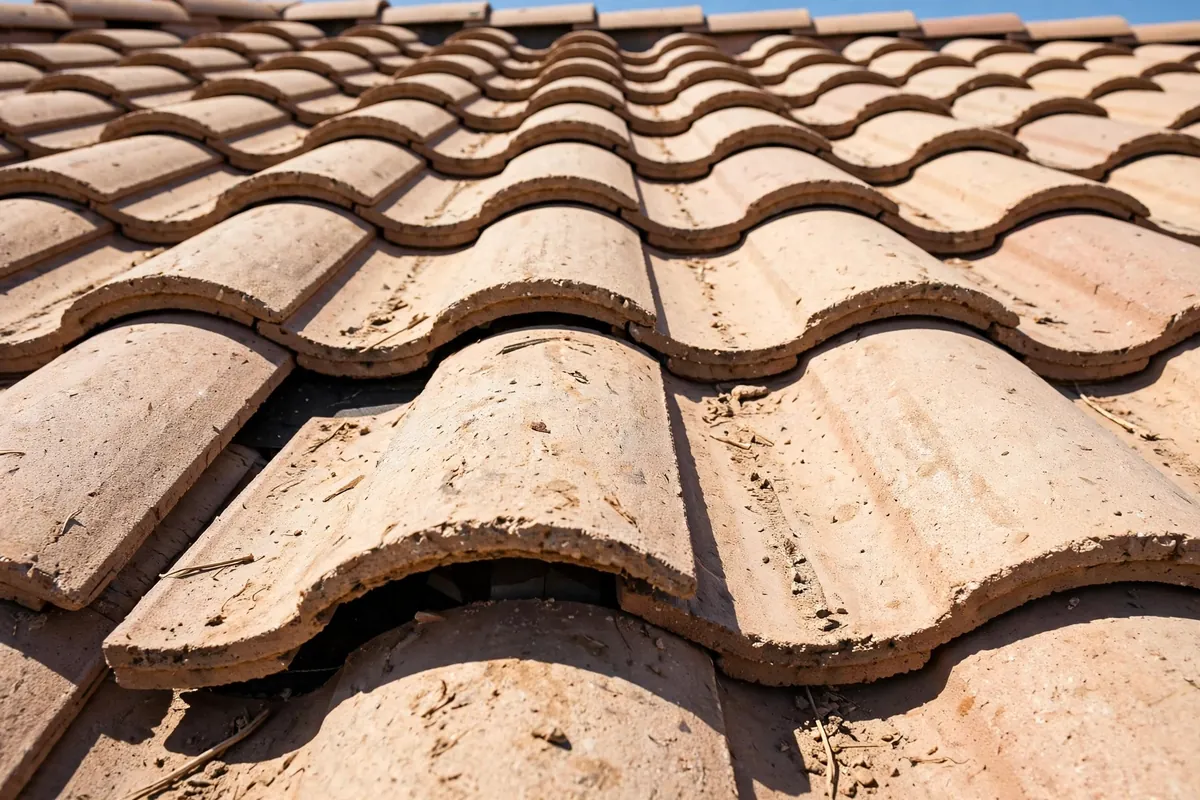
Tile roofs: the tile lasts decades — the underlayment decides
Tile is the most common covering in Scottsdale, and it is also the most misunderstood. Clay and concrete tiles are remarkably tough: they handle heat and sun better than almost any other covering, and the National Association of Home Builders puts clay and concrete tile at a life expectancy of over 50 years. On a Scottsdale home, the tiles themselves can outlast the next two owners. But the tiles are not the waterproof layer. They are a rain shield and a sunshade. The waterproofing is the underlayment — the layer fixed to the roof deck beneath the tiles — and in Arizona heat it typically needs replacing every 15 to 25 years.
That is the number that decides a tile roof's real life. When the underlayment dries out, cracks at the fasteners and laps, and stops sealing, water finds its way in even though the tiles above still look sound. The fix is a lift-and-relay: the sound tiles are lifted off, the underlayment is replaced, and the same tiles go back on — which is why a tile roof can serve a home for 50 years or more across two underlayment cycles. What to watch for: slipped, cracked or broken tiles, because each one exposes the underlayment to sun and rain and shortens its life; dark patches where a tile is missing; and any stain in the attic, which usually means the underlayment has already given way somewhere. A tile roof that is checked twice a year, with slipped tiles reset promptly, gives its underlayment the easiest possible life.
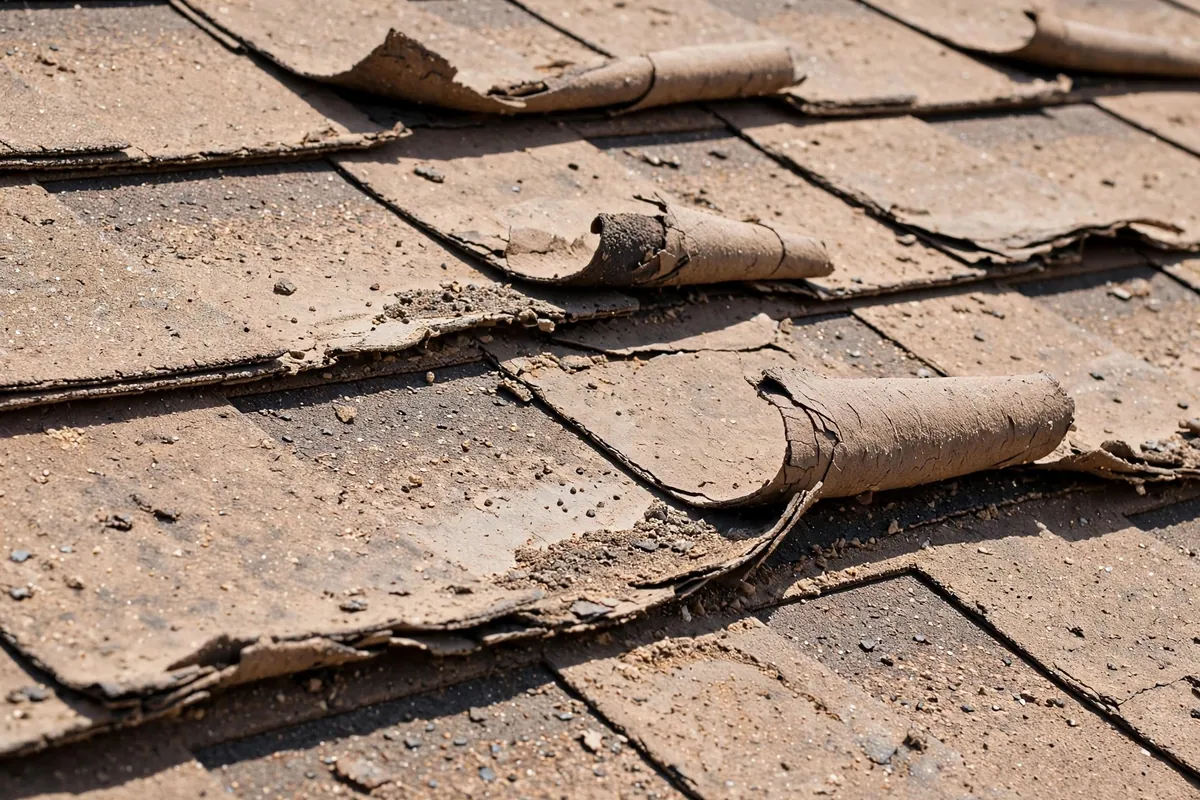
Shingle roofs: 15 to 25 years in desert sun
Asphalt shingles are the budget-friendly pitched option, and in Scottsdale they live at the short end of every manufacturer range. The sun is the reason: UV and heat dry the shingles out, wear away the protective granules, and leave the surface brittle. Manufacturers' brochures often quote 25 to 30 years, but on a Scottsdale roof the realistic range is 15 to 25 years — and the thinner three-tab shingles land at the short end of that, which is why most roofers here no longer recommend them for new installs.
Granule loss is the earliest sign. Check the gutters: a small amount of granules is normal, but a heavy load means the surface is wearing faster than it should. Then look at the shingles themselves — curling edges, cracking, and patches where the colour has faded unevenly all mean the surface is aging. Heat also works on the sealant strips that hold shingles together: in high summer, shingles can soften and re-seal in a slightly lifted position, leaving edges the next wind can catch. After a windy storm, look for shingles that have lifted or creased. A shingle roof that is kept clear of debris and checked after storms will reach the far end of its range; one that is ignored will not.
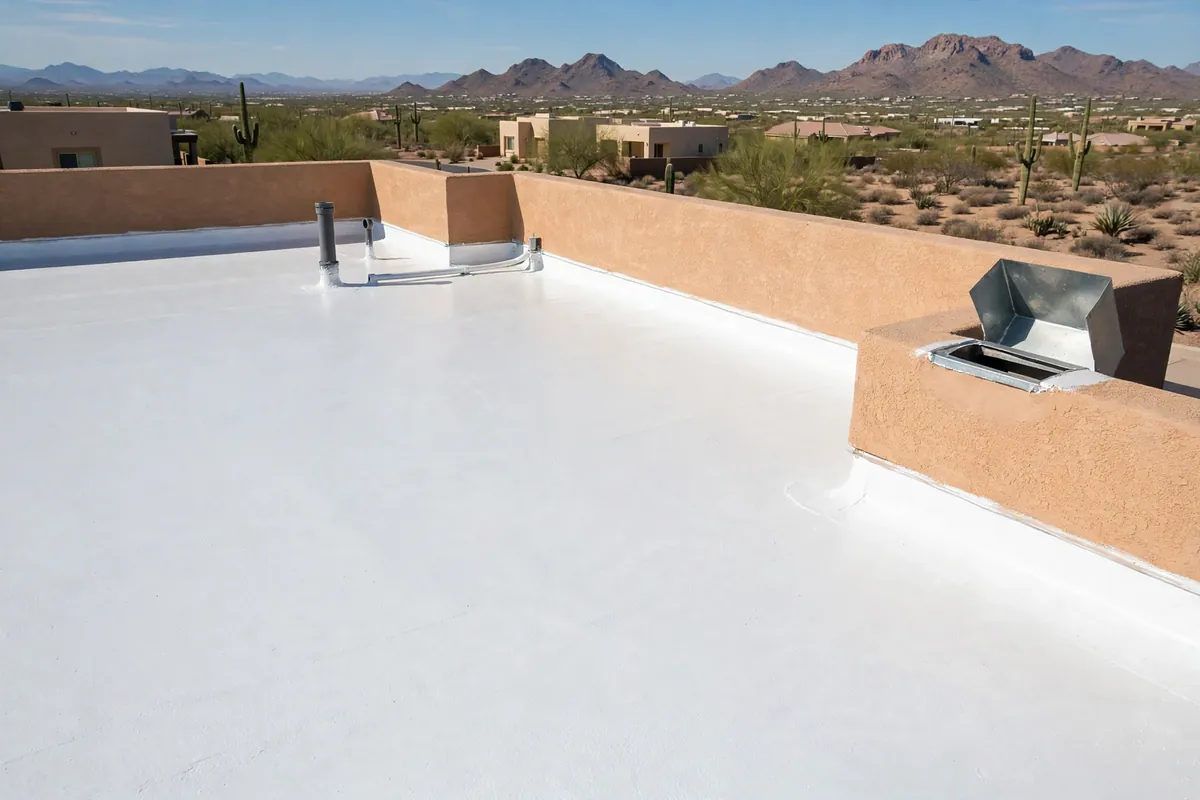
Flat and foam roofs: decades — if the coating is renewed
Spray foam is the standard for flat and low-slope roofs in Scottsdale, and it works on a different clock from the rest. The foam itself is durable, but it is protected by a coating, and the coating is what the sun attacks. The rule that keeps a foam roof alive is simple: recoat every 5 to 10 years, before the foam beneath is exposed. Kept to that cycle, a foam roof can last for decades. Neglected, the coating wears thin, turns chalky and peels, and the foam beneath starts to break down — at which point the repair is much bigger than a recoat. Watch for coating that is thin, patchy or peeling, seams that have opened, and ponding — water still standing a day after rain, which means the drainage is not working. Scuppers, the openings in the parapet that let water off a flat roof, block easily with leaves and dust, so clear them before monsoon season and check them after each storm. The coating side of this work is covered by our roof coating services.
Metal roofs: 40 to 70 years
Metal roofs are the long-life option on a pitched roof: 40 to 70 years, with the strongest UV and wind performance of any common covering. Standing-seam metal in a coated finish reflects heat well and holds up to monsoon gusts, and it needs little beyond the same checks as any other roof — fasteners, flashing and sealant. The main constraint in Scottsdale is not the material but the neighbourhood: some HOAs only accept certain profiles and colours, so the choice has to clear architectural review before anything else. Where it is allowed, metal is the roof you fit once and then largely stop thinking about.
What shortens a roof's life in Scottsdale
Material sets the range, but five things decide where inside that range your roof lands. The first is installation: a roof that was fitted well — underlayment lapped correctly, flashing sealed, fasteners set right — starts with years in hand, while a poorly fitted roof can fail in a decade whatever the material. The second is ventilation: an attic that cannot breathe runs far hotter than the outside air, and that heat ages the roof from underneath while the sun ages it from above.
The third is maintenance, or the lack of it: gutters and scuppers left blocked, valleys left full of debris, slipped tiles left unreset. Small problems left alone become the leaks that end a roof's life early. The fourth is trees and dust — overhanging branches that drop leaves and scratch tiles in the wind, and fine dust that holds moisture against every surface. The fifth is the wrong material for the roof: shingles on a low slope that ponds, or a coating left past its recoat date on a flat roof. None of these is dramatic on its own. Together, over years, they are the difference between a roof that reaches the far end of its range and one that does not.
Signs your roof is near the end of its life
A roof rarely fails without warning. From the ground, with binoculars, look for tiles sitting at a different angle from their neighbours, a line of tiles that no longer runs straight, shingles curling or missing, and any patch where the colour has faded unevenly. Look at the gutters for a heavy load of granules, and at the flashing around chimneys, vents and skylights for metal that has lifted or rusted. Inside, the attic tells the rest: stains on the decking, damp insulation, daylight where it should not be, or a musty smell that was not there last year.
The clearest signs the end is near:
- Leaks that keep coming back in the same place, or new stains after every storm
- Underlayment at the end of its life across the whole roof, not just one patch
- Widespread granule loss, or shingles curling and cracking across whole slopes
- Coating worn thin everywhere on a flat roof, with seams opening in several places
- Repairs that used to hold for years now failing within months
One or two of these on a single slope usually means a repair. Most of them, across the whole roof, means the roof is telling you its working life is over. If you are unsure which side of that line your roof sits on, a roof inspection in Scottsdale will give you written findings and photographs to decide from — including the underlayment's condition, which you cannot judge from the street.
Repair or replace? How to decide
This is the question the lifespan numbers are really for, and the answer comes from how widespread the wear is. If the problems are local — a run of slipped tiles, a failed flashing, a worn patch of coating, one slope of curling shingles — repair is usually the sensible answer, and a good repair buys years. If the problems are general — underlayment at the end of its life across the whole roof, widespread granule loss, coating worn thin everywhere — then the honest answer may be a larger job.
On a tile roof, that larger job is often a lift-and-relay rather than a full replacement: the sound tiles come off, the underlayment is renewed, and the tiles go back on for another two or three decades. On a flat roof, it is a full recoat or a new foam layer. On a shingle roof, it is usually a new roof, because shingles cannot be lifted and reused. The maintenance record helps enormously here: a roof with a written history — what was found, when, with photographs — makes the decision straightforward, while a roof with no record leaves you guessing. If the decision is replacement, our roof replacement in Scottsdale page sets out how that work runs, including the permit and HOA steps that come with it.
How to make your roof last longer
The cheapest years of a roof's life are the ones maintenance buys. Ask any roofer, "How long does a roof last in Scottsdale?" and the answer will start with the material — then move straight to how the roof has been looked after. Twice a year — spring and autumn, with a focused check before monsoon season — walk around the house and look at the roof from the ground, clear the gutters, downspouts and scuppers, trim back overhanging branches, and look in the attic for stains, damp and daylight. After any significant storm, repeat the ground-level look and the inside check, even if the roof looked fine before.
Write down what you find each time, with dates and photographs. A short record, kept over a few years, shows whether a small stain is growing, whether the same valley keeps collecting debris, and whether the coating on a flat roof is thinning faster than expected. It also makes a professional inspection more useful, because the inspector can see the history rather than just the present moment. The full rhythm is set out in our guide to how to maintain your roof for Scottsdale's climate, and our roof maintenance in Scottsdale service covers the scheduled care described here. A roof that is looked after lasts longer, leaks less, and costs less over its life than a roof that is ignored until something goes wrong — and in Scottsdale's sun, that difference is measured in years.