Gainey Ranch Golf Club
The course threads between the lakes and the homes, and the fairway-facing slopes take the open monsoon wind straight off the course.
Roof repair Gainey Ranch Scottsdale is tile work around water and golf. The homes here were built in the 1980s and 1990s around lakes and the golf course, and most of them wear concrete tile roofs that are now reaching the age where the layer beneath the tile starts to fail. We trace each leak to its entry point, repair the failed underlayment or flashing, and leave a written account with photos of what was found and what was done.
Tell us where the water is showing, whether the roof is tile, and roughly how old the home is. That is enough for us to talk through what the visit will involve and what happens next.
Call +1 (480) 907-0320 →Would you rather write? roofrepairsscottsdale3@gmail.com is the address for Gainey Ranch roof questions.
Open 24 hours · 7 days a week — a real person answers.Gainey Ranch homes are mostly tile, mostly from the same two decades, and mostly facing the same underlayment question.
Gainey Ranch roofs were built in a short window, so they are aging together.
Concrete tile can last decades, but the underlayment beneath it commonly lasts 15 to 25 years in this climate. The 1980s homes in Gainey Ranch are past that window now, and the 1990s homes are entering it. The first sign is usually a stain below a valley or a penetration, on a roof that still looks fine from the street.
The lakes and the golf course make Gainey Ranch green, and that greenery lands on roofs. Palm fronds and leaves pack into valleys and gutters, holding damp against the underlayment long after the rain stops. Morning moisture off the lakes keeps shaded slopes damp longer, and monsoon wind crossing the open fairways drives rain under tile edges on the lakeside slopes.
Three faults account for most of our Gainey Ranch visits, and all three start with age or with debris.
Most Gainey Ranch tile went on in the 1980s and 1990s, and the underlayment in the valleys is now at the end of its first life. A stain below a valley, after a storm, is the usual early warning.
How we help: We lift the tile along that valley, renew the underlayment beneath it, and relay the tile so the water runs clear again.
Fronds and leaves from the lakeside palms settle into valleys and hold damp against the underlayment, speeding wear where the most water runs.
How we help: We clear the valleys and gutters, check the underlayment beneath the debris, and repair any wear the damp has already caused.
Around Gainey Ranch, skylights and vents are the most common penetration leaks, because the flashing there moves with heat and is hard to see from the ground.
How we help: We reseal the flashing and, where it has moved, refit it, then check the sealant at every penetration on that slope.
A ceiling stain under a valley that darkens a little more after each storm
Palm fronds and leaves packed into a valley that stays damp
A skylight that drips only in wind-driven rain
Cracked or slipped tiles visible from the garden or the fairway
A musty smell in a room below the lakeside slope of the roof
A repair in Gainey Ranch depends on how much of the hidden layer has failed and how much debris has to be cleared first.
When you call about roof repair Gainey Ranch Scottsdale, have three details ready: the age of the home, the roof material, and the room where the water appears.
Around the lakes of Gainey Ranch, renewing a valley covers more area than resetting one tile, and the job grows with the length of underlayment that has worn.
Valleys packed with palm fronds take clearing before the repair can even be seen, and mature trees around the home shape how the roof is reached.
Matching the tile profile and colour already on the roof keeps the repair invisible from the street, and that matching takes extra care.
Homes along the fairways take the open monsoon wind from the course side, so ridge caps and windward laps on that side often need more attention.
These are the places we use to find our way through Gainey Ranch, from the lakes to the golf course.
The course threads between the lakes and the homes, and the fairway-facing slopes take the open monsoon wind straight off the course.
The lakes sit at the centre of the community.
The clubhouse marks the heart of Gainey Ranch, and the streets around it hold some of the earliest homes in the community.
We work across Gainey Ranch, from the lakeside streets to the homes along the golf course.
Gainey Ranch Estates · The Lakes · Golf Villas · Scottsdale Road corridor
No answer to your question here? Call and ask about the tile roof on your Gainey Ranch home, and mention whether it faces the lakes or the golf course.
Call +1 (480) 907-0320 →The tiles themselves are not the waterproof layer — the underlayment beneath them is. That layer commonly lasts 15 to 25 years, and Gainey Ranch homes from the 1980s and 1990s are now in or past that window, so water gets through worn underlayment at valleys and penetrations while the tiles above still look sound.
They do, indirectly. Fronds and leaves pack into valleys and gutters and hold damp against the underlayment long after the rain stops, and that damp speeds wear exactly where the most water runs.
The association keeps standards for visible changes, and tile profile and colour are part of them. We match what is already on the roof before any tile is replaced, and the repaired slope should blend with the homes around it.
In Gainey Ranch we suggest a spring check that clears palm debris from the valleys and looks at the lakeside underlayment, then an autumn check after the monsoon, when fairway wind has tested the ridge caps and the damp has had a season to work.
The sound tiles are set aside, the underlayment beneath them is renewed, and the same tiles go back on the slope.
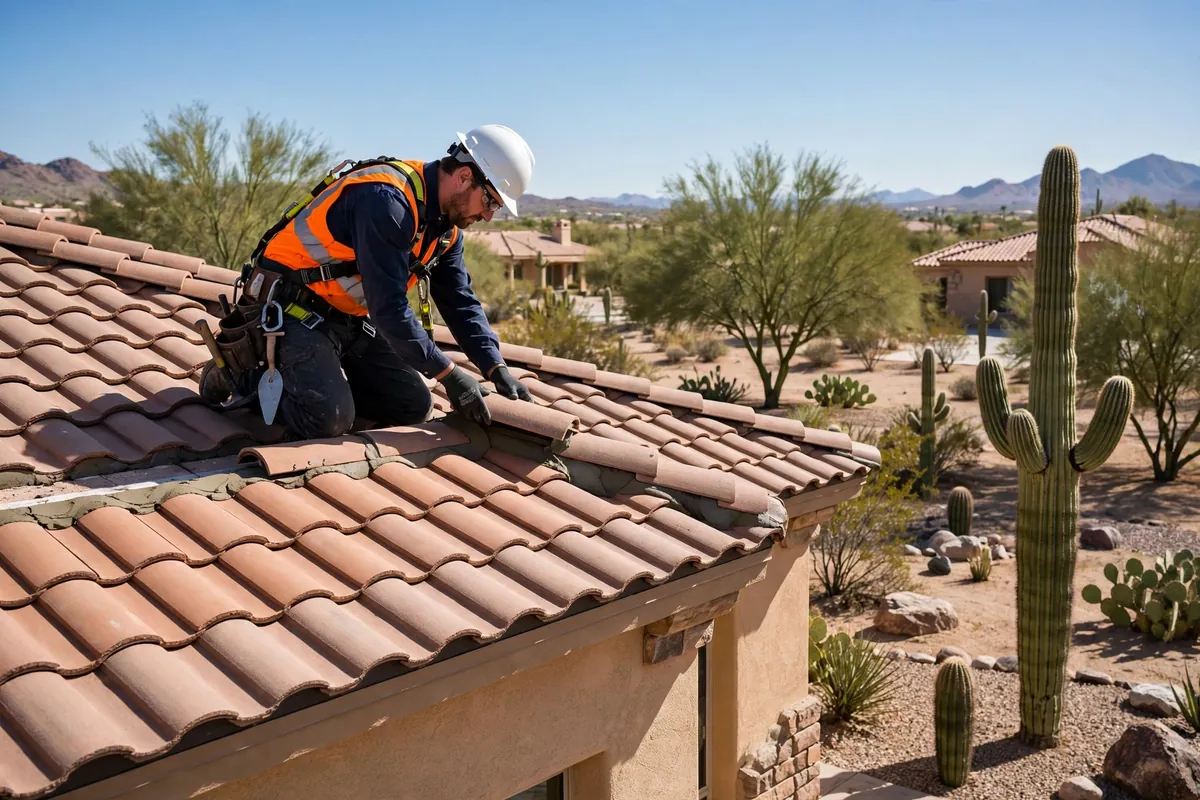
A stain below a valley, a skylight that drips when the wind drives the rain, or a tile roof from the 1980s or 1990s — call and tell us what you are seeing.
Our house is large with a tile roof, and the valleys carry a lot of monsoon water. They found the valley flashing was worn and the underlayment underneath was thin. They replaced both, and the water runs cleanly off the roof now.
The HOA tile-profile rules meant our repair had to match the original tiles exactly. They sourced the right profile, fitted it neatly, and the roof looks untouched. The valleys are clear, and the house is dry.
The hips and valleys on our roof take a beating in the monsoon, and a few tiles had slipped. They reset the tiles, checked the flashing, and cleared the valleys of leaves and dust. The roof has been through two storms since without a drip.
Tell us where the home sits in Gainey Ranch and where the water is showing. The simplest way to reach us is a call, and photos by email are welcome too.