Flat Roof Repair in Scottsdale
Flat roof repair in Scottsdale starts with the drainage: ponding water, blocked scuppers, worn foam coating and parapet leaks — and the repair that fixes the cause, not just the stain.

· Roof Repairs Scottsdale
Flat roof repair in Scottsdale is a different job from roof repair almost anywhere else, because a flat roof here is not really flat, and it does not fail the way a pitched roof fails. A pitched roof sheds water the moment rain lands on it. A flat roof has to hold the water, move it slowly toward a drain or a scupper, and keep it out while it waits. That is why the leak you see on the ceiling is so often far from where the water actually got in — water travels sideways under a flat roof surface, along the deck, until it finds a weak spot to drip through. The repair that works is the one that finds the entry point, not the stain.
This guide explains what flat roof repair really involves on a Scottsdale home: the four problems that cause most flat roof leaks, the roof systems you will find behind the parapet walls of this city, how a proper repair is done step by step, and how to tell whether your roof needs a small repair, a recoat, or something bigger. If you have a stain on the ceiling, water standing on the roof days after rain, or a foam coating that has gone from white to tan, this is the guide to read first.
Why flat roofs in Scottsdale leak
Scottsdale has more flat roofs than most American cities, and the reason is the architecture. Pueblo Revival and Santa Fe-style homes hide their roofs behind stucco parapet walls. Mid-century ranch houses have flat sections over additions, patios and carports. Townhomes, condominiums, shops and offices across the city sit under low-slope roofs too. Walk through Old Town, McCormick Ranch or Gainey Ranch and most of the roofs you cannot see are flat — sealed with spray foam or a membrane, and edged with parapets.
Three forces work on these roofs every day. The first is the sun. A flat roof surface in Scottsdale regularly gets far hotter than the air temperature in summer, and that heat dries out sealants, thins foam coatings, cracks parapet stucco and pulls at seams a little more with every day. The second is the way rain arrives. From mid-June through September, monsoon storms drop heavy rain in short bursts, and a drain or scupper that was fine for a light shower can be overwhelmed in minutes. Winter storms are different — steadier, longer rain that soaks a weak seam for hours. The third is dust and debris. Haboobs and everyday desert wind push dust, leaves, palm fronds and palo verde pods onto the roof, and they collect exactly where the water needs to go: at the drains, the scuppers and the low corners.
Put those three together and the pattern of a Scottsdale flat roof leak becomes predictable. The coating wears thin, the drainage clogs, the water ponds, and the pond finds the weak seam or the cracked parapet flashing. Fixing the stain on the ceiling without fixing that chain is why so many flat roof leaks come back after the next storm.
The problems flat roof repair fixes
Most flat roof leaks in Scottsdale come from one of four problems, and a good repair starts by working out which one — or which combination — is behind yours. They look different, they are fixed differently, and confusing one for another is the most common reason a repair does not hold.
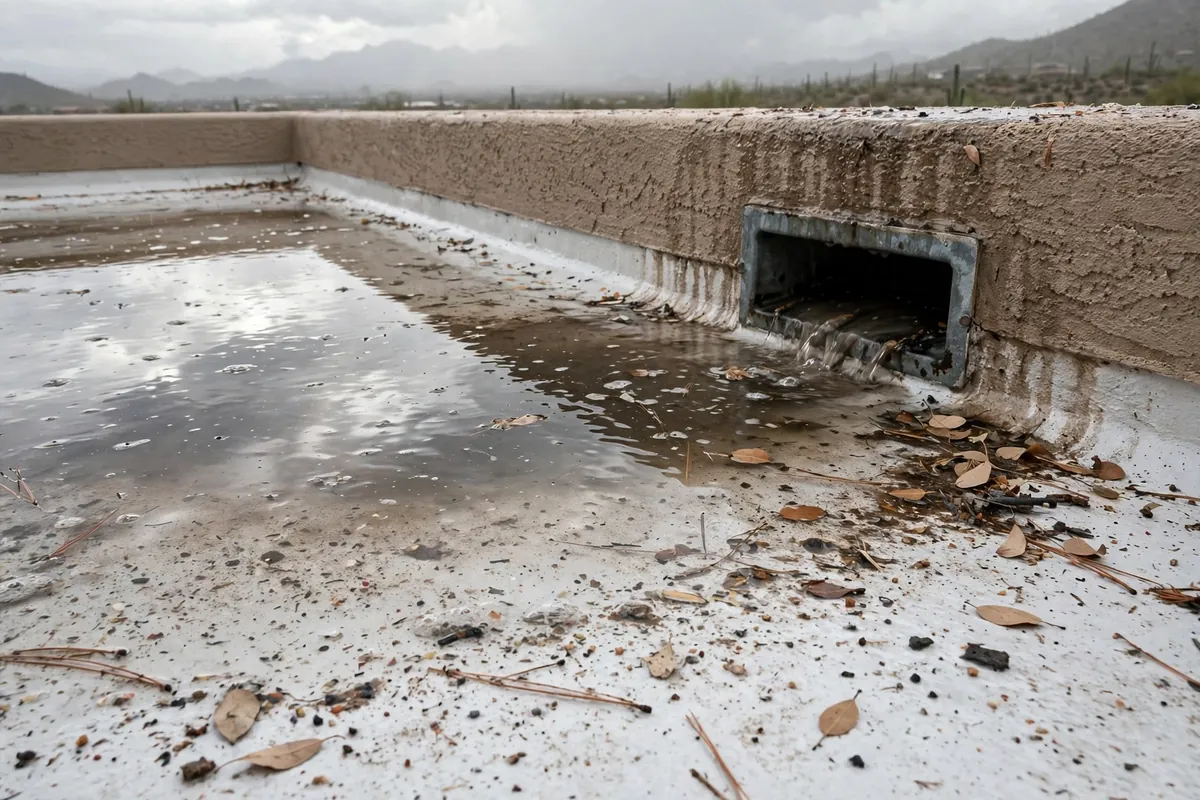
Ponding water: the slow leak that starts at the drain
A flat roof is never perfectly flat. It is built with a slight fall — usually just enough slope to move water toward the scuppers or drains. When a scupper is blocked with leaves, or the fall has settled over the years, water ponds. A shallow pond after a storm is normal for a day or so. Water that is still standing two days later is a problem, and water that stands for days after every storm is the single most reliable warning sign on a flat roof.
Ponding water does its damage slowly and then all at once. It adds weight to the deck, it speeds up the wear on the coating or membrane underneath it, and it keeps every seam and penetration in the ponded area wet long after the rest of the roof has dried. A seam that would survive a quick monsoon burst can fail after a week of standing water. That is why the first step of any flat roof repair in Scottsdale is the drainage: clear the scuppers and drains, check the fall of the roof, and only then repair the surface. A patch laid over a pond that is still forming will be underwater again with the next storm.
Homeowners can check this themselves after rain, safely from the ground or from a window that looks onto the roof: is there still water standing two days after the storm, and is it always in the same place? If the answer is yes, the roof has a drainage problem, and that is the repair to make first.
Worn foam coating and open seams: the surface gives up first
Many Scottsdale homes have spray foam roofs — foam sprayed over the deck and protected by a white elastomeric or silicone coating. The foam is the waterproof layer and the insulation in one. The coating is what stands between the foam and the sun, and it is the part that wears out. When it is fresh it is bright white and it reflects the heat. As it thins it goes chalky, then tan, then the foam underneath starts to show. Bare foam absorbs water like a sponge, and once it is wet it stays soft underfoot — a sign you can feel, and a sign that the coating has been gone for a while.
On membrane roofs — TPO, modified bitumen and built-up roofs — the weak point is usually the seam. Heat cycling pulls at seams a little every day, and after years of hot afternoons and cool desert nights a seam can open just enough to let water in. The repair depends on the system: foam is cut out, re-sprayed and recoated; a membrane is patched with a matching material; modified bitumen gets a reinforced patch and new cap sheet. The rule is the same in every case: the repair has to bond to sound material, so damaged coating, wet foam and failed membrane come off before anything new goes on.
Seams and coatings also fail at the places people walk. Air conditioning units, evaporative coolers and solar equipment sit on many Scottsdale flat roofs, and every service visit puts foot traffic and tools on the surface. The curbs and condensate lines around that equipment are among the most common leak sources on an otherwise sound flat roof — which is why a repair visit should always include a look at the penetrations, not just the field of the roof.
Parapets, scuppers and canales: where most flat roof leaks start
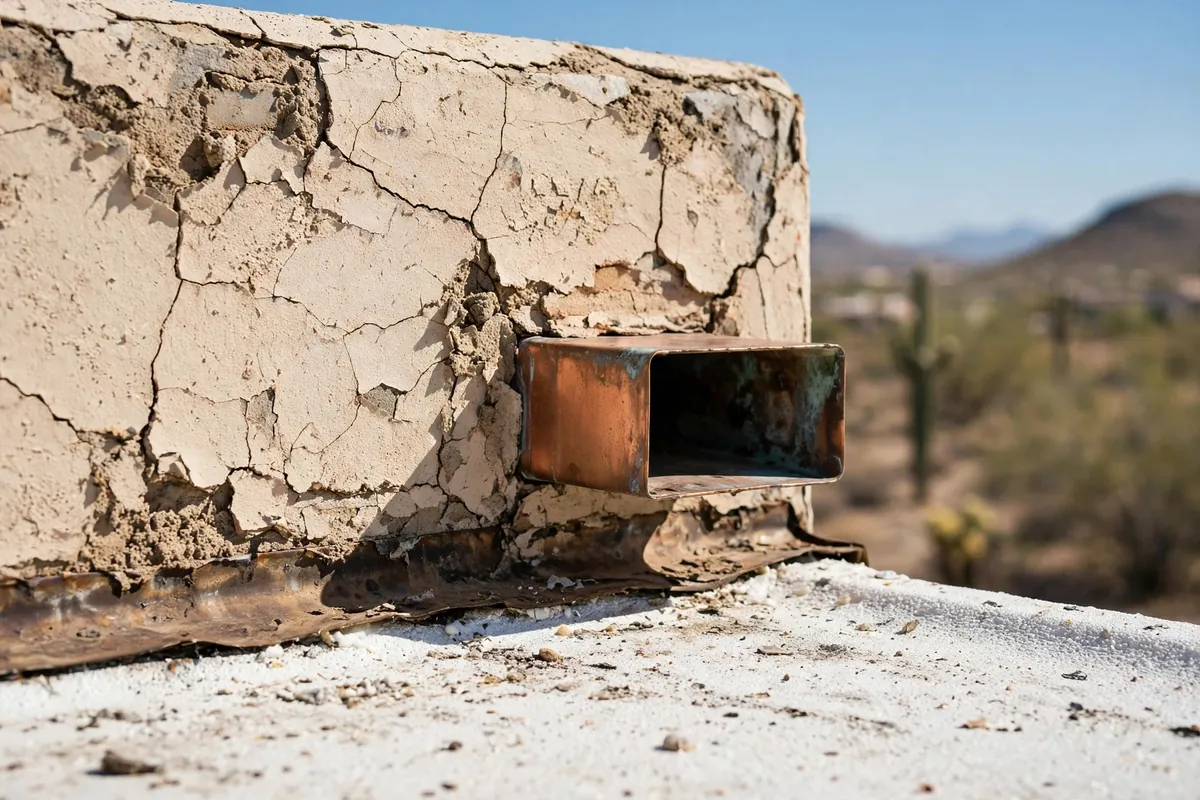
If there is one thing that surprises Scottsdale homeowners about flat roof leaks, it is this: the leak often starts in the wall, not the roof. A parapet is the low stucco wall that runs around the edge of a flat roof, and it creates more joints than any other part of the building. There is the joint where the roof surface turns up the wall, the joint where the parapet cap sits on top, and the joint where stucco meets metal flashing. Stucco cracks as it moves with the heat, and once a crack opens, water runs inside the wall and behind the roof flashing — and shows up as a stain on an interior wall, far from the actual leak.
Water leaves a flat roof through scuppers or canales — openings cut through the parapet, sometimes with a decorative copper or metal liner. When a scupper is partly blocked by dust or leaves, or a canale liner has cracked, water backs up behind the parapet and leaks at the base of the wall during a monsoon downpour. In Downtown Scottsdale, where the roofs are mostly low-slope and parapet-edged and the buildings are older, blocked scuppers and worn parapet caps are the most common flat roof problems we find. The repair starts with the drainage — clear scuppers, sound caps, sealed seams — and only then the field of the roof itself.
The tell-tale sign of a parapet leak is a stain along an exterior wall or on a ceiling near the edge of the building, rather than in the middle of a room. Our guide on why your roof is leaking in Scottsdale walks through how to read where a stain sits and what it points to. If the stain is near a parapet, the parapet and its scupper are the first places to look — not the middle of the roof.
Foam, membrane or built-up: what kind of flat roof do you have?
Before any repair, it helps to know which system is on your roof, because each one is repaired differently. Most Scottsdale flat roofs are one of four types. Spray foam with a coating is the most common on homes: seamless, insulating, and easy to repair in small areas because new foam blends into old foam when the coating is matched. It needs its coating renewed on a schedule, and that schedule is the difference between a foam roof that lasts and one that fails early.
TPO is a single-ply white membrane with heat-welded seams, common on newer homes and commercial buildings. Its repairs are clean — a patch is welded on with heat — but only if the surrounding membrane is still sound. Modified bitumen is a layered, torch- or adhesive-applied system with a mineral cap sheet; it is repaired with reinforced patches and new cap sheet. Built-up roofing, the older gravel-surfaced system, is patched with compatible plies. A roofer who knows the system will match the repair to it; a patch made from the wrong material will not bond, and it will peel at the first hot summer.
If you are not sure which system you have, the colour and texture are the clues. A smooth, bright white surface that feels slightly soft is usually foam. A smooth white sheet with visible welded seams is usually TPO. A dark, granular surface is usually modified bitumen or built-up. And if you are planning a new flat roof rather than a repair, our flat roof installation page explains the systems side by side. Knowing the system also matters for the decision in the next sections — a recoat makes sense on foam, a patch makes sense on a sound membrane, and neither makes sense on a roof whose surface has failed everywhere.
What a flat roof repair involves, step by step
A proper flat roof repair follows the same order every time, and skipping a step is how a leak comes back. First comes the inspection — from inside, where the water appears, and then on the roof above, checking the membrane or coating, the seams, the penetrations, the drainage and the parapets. Summer visits are scheduled early in the morning, before the surface gets too hot to work on safely. Second comes the leak tracing: because water can travel along the deck before it drips, the stain on the ceiling is the end of the trail, not the start. Visible damage, moisture probing and the layout of the roof are used to work back to the entry point.
Third, the damaged material comes off. Wet insulation, failed membrane, cracked coating and loose flashing are removed so the repair bonds to sound material. This is the step that separates a repair from a cover-up: a patch laid over wet foam or a failed seam will not hold, however neat it looks on the day. Fourth, the surface is repaired with materials that match what is already there — foam cut out and re-sprayed, membrane welded, bitumen patched, flashing rebuilt or resealed. Our roof leak repair page covers the same process for pitched roofs, and the principle is identical: fix the entry point, not the stain.
Fifth, and just as important, the drainage is corrected. Scuppers and drains are cleared, strainers are replaced, and low areas are dealt with — sometimes with a cricket, a small raised wedge that diverts water toward the drain, or with a recommendation for an added drain where water keeps ponding. Finally comes the check: the repair is looked over after the next rain, or water-tested where that is safe, to confirm the leak is gone. A repair that is never checked after rain is a repair that is still a guess.
Repair, recoat or replace? How to decide
Every flat roof owner eventually faces the same three-way choice, and the honest answer depends on what has actually failed. A repair makes sense when the problem is local: one bad seam, one worn spot, one blocked scupper, one cracked parapet cap, and the rest of the roof is sound. A patch on a healthy roof can last for years, and it is the right call most of the time.
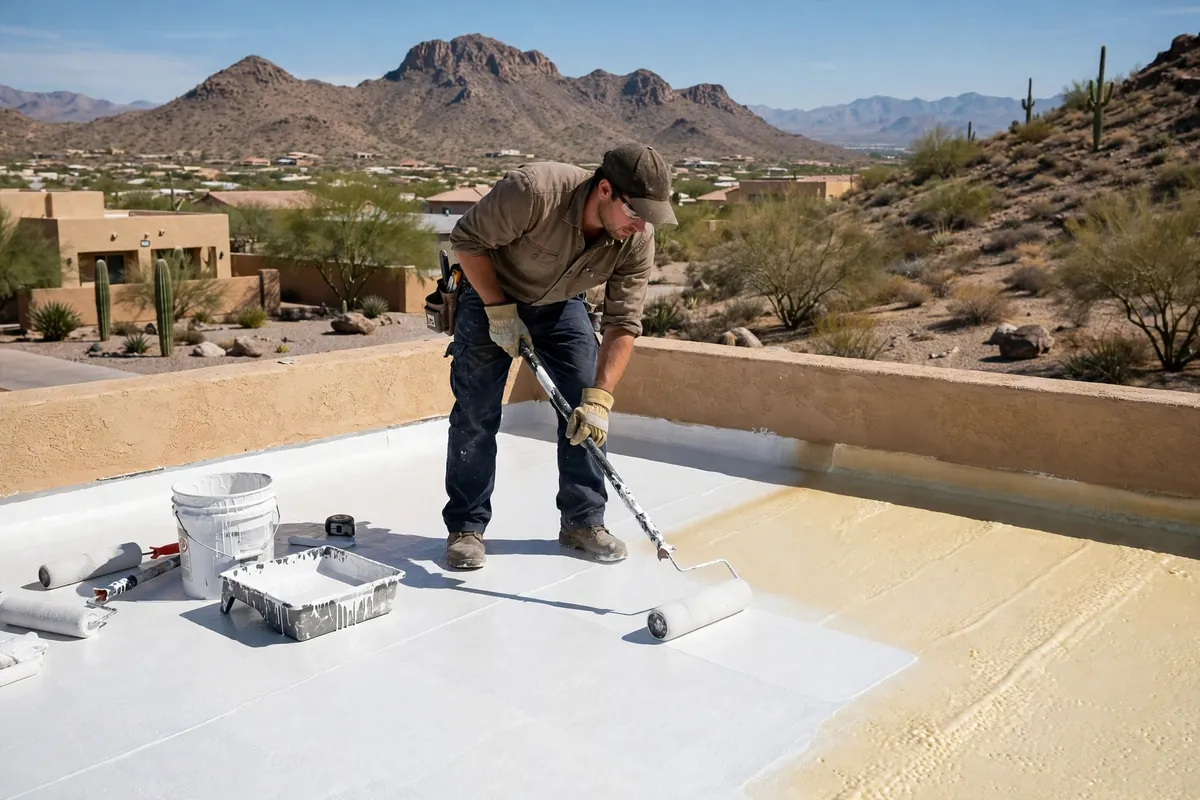
A recoat makes sense on a foam roof when the coating has worn thin across the roof but the foam beneath it is still dry and firm. The old coating is cleaned and prepared, and a new coat is rolled on — which is also the moment to fix the small seams and penetrations underneath it. A recoat is not a repair for wet foam: if the foam is soft underfoot or the roof has been ponding for a long time, coating over it only hides the problem. Our roof coating services page explains what a recoat covers and what it cannot fix.
Replacement starts to make sense when the problem is no longer local: many failed seams rather than one, a membrane that is dry and hard and cracks instead of flexing, water that sits for days after rain, soft or wet foam across a wide area, or repeat leaks in different spots after past patches. That is the point where patching one spot at a time costs more than fixing the roof properly, and where each new patch is laid on material that is already tired. The guide on how long a roof lasts in Scottsdale gives the expected life of each roof type in this climate, which is the other half of the decision — a roof near the end of its expected life is a different conversation from a roof that is ten years old with one bad seam.
What to check before you call
A few minutes of looking before you call makes the repair visit faster and the diagnosis better. After rain, note where water stands on the roof and for how long — a photo from a window that looks onto the roof is worth more than a description. Inside, note where the stain is: the middle of a room, near an exterior wall, below an air conditioning unit, or under a parapet. Note when it appeared: after a monsoon burst, after a long winter rain, or after a service visit to the roof. And if you can, note what your roof is: foam, membrane or built-up, and roughly how old it is. A roofer who arrives with those four facts can spend the visit finding the leak instead of hunting for the roof type.
Two things are worth doing right away, whatever the cause. Keep the scuppers and drains clear — leaves and dust are the cheapest repair on a flat roof, and the one most often skipped. And do not let a small stain wait through a monsoon season: water that has found one path will widen it, and a leak that is a patch today can be wet insulation, a soft deck and a bigger job by September. The seasonal routine in our climate guide — a look before monsoon season and a look after it — is the simplest habit a flat roof owner can keep.
The takeaway: drainage first, coating second
A flat roof in Scottsdale fails in a predictable order: the coating wears thin, the drainage clogs, the water ponds, and the pond finds the weak seam or the cracked parapet. Flat roof repair works when it follows that order in reverse — clear the drainage, fix the surface that failed, and check the repair after the next rain. If your roof holds water for days after a storm, if the foam coating has gone from white to tan, or if a stain keeps coming back in the same place, the roof is telling you which part of the chain has broken. Call us at +1 (480) 907-0320 and we will find the entry point, fix the layer that failed, and leave you a roof that is ready for the next monsoon.