Tile Roof Repair in Scottsdale
Tile roof repair in Scottsdale starts with the layer that failed: cracked and slipped tiles, loose ridge caps, worn valleys — and the underlayment beneath them that causes most tile roof leaks.

· Roof Repairs Scottsdale
Tile roof repair in Scottsdale is a different job from roof repair almost anywhere else, because a tile roof here is two roofs in one. The tiles you can see — clay or concrete, in the terracotta, sand and slate tones that define Scottsdale neighbourhoods from McCormick Ranch to DC Ranch — are a shield. They take the sun, shed most of the rain and protect what sits underneath. The roof that actually keeps water out is the layer you cannot see: the underlayment fixed to the deck beneath the tiles. When a tile roof leaks in Scottsdale, the tile is rarely the whole story, and the repair that works is the one that fixes the layer that failed, not just the tile that cracked.
This guide explains what tile roof repair really involves on a Scottsdale home: the problems that show up on the surface, the hidden one that causes most leaks, how a repair is done properly, and how to tell whether your roof needs a small repair, a lift-and-relay, or something bigger. If you have a cracked tile, a stain on the ceiling, or a roof that is simply getting old, this is the guide to read first.
Why tile roofs in Scottsdale need repairs
Tile is the most common covering on Scottsdale homes for good reason: clay and concrete tile handle desert heat better than almost any other material, and the tiles themselves can last 40 to 50 years or more. But four forces work on them every day, and each one creates a different kind of repair. The first is the sun. Ultraviolet light and heat dry out the mortar that holds ridge caps in place, age the underlayment beneath the tiles, and make sealants brittle. The second is thermal cycling — the daily swing between hot afternoons and cool desert nights — which makes tiles, mortar and flashing expand and contract, loosening fixings a little at a time.
The third is monsoon weather, from 15 June to 30 September: heavy rain in short bursts, strong gusts and sometimes hail, which test every weak point at once and find the tile that was already loose. The fourth is the most ordinary of all: foot traffic. Tiles crack when they are walked on the wrong way, and every visit to the roof — for a satellite dish, a solar panel, a swamp cooler, a Christmas light — is a chance for a tile to break. Add dust that collects in valleys and holds moisture against the surface, and you have the full picture. A tile roof does not usually fail all at once. It wears down in the places where these forces work hardest, and the repairs it needs follow the same pattern.
The problems tile roof repair fixes
Most tile roof repairs in Scottsdale fall into five groups, and knowing which one you are looking at is half the job. Cracked and broken tiles are the most visible: a tile split by hail, by a falling branch, or by a foot in the wrong place. Slipped and missing tiles come next — a tile that has shifted out of line or slid down the slope, leaving a gap where the underlayment is suddenly exposed to sun and rain. Then there are ridge and hip caps: the half-round tiles along the top of the roof, bedded in mortar, which loosen and crack as the mortar dries out in the heat.
Valleys and flashing are the fourth group. Valleys are the channels where two roof slopes meet and water concentrates, and the metal flashing around chimneys, skylights, vents and pipes is where water is most likely to find a way in. The fifth group is the one homeowners never see until it is too late: the underlayment beneath the tiles, which in Arizona heat typically lasts 15 to 25 years — far shorter than the tiles above it. When it dries out, cracks and stops sealing, water gets through even though the tiles still look sound from the street. A proper roof leak repair in Scottsdale starts by working out which of these five is actually causing the leak, because fixing the wrong one leaves the leak exactly where it was.
- Cracked or broken tiles: split by impact, hail, or foot traffic; each one exposes the layer beneath
- Slipped or missing tiles: shifted out of line by wind, age or movement; a gap that lets water straight in
- Ridge and hip caps: mortar dried out by the sun, caps loosened, cracked or missing
- Valleys and flashing: metal worn, lifted or rusted where water concentrates
- Underlayment failure: the hidden waterproof layer dried out and cracked, usually after 15 to 25 years
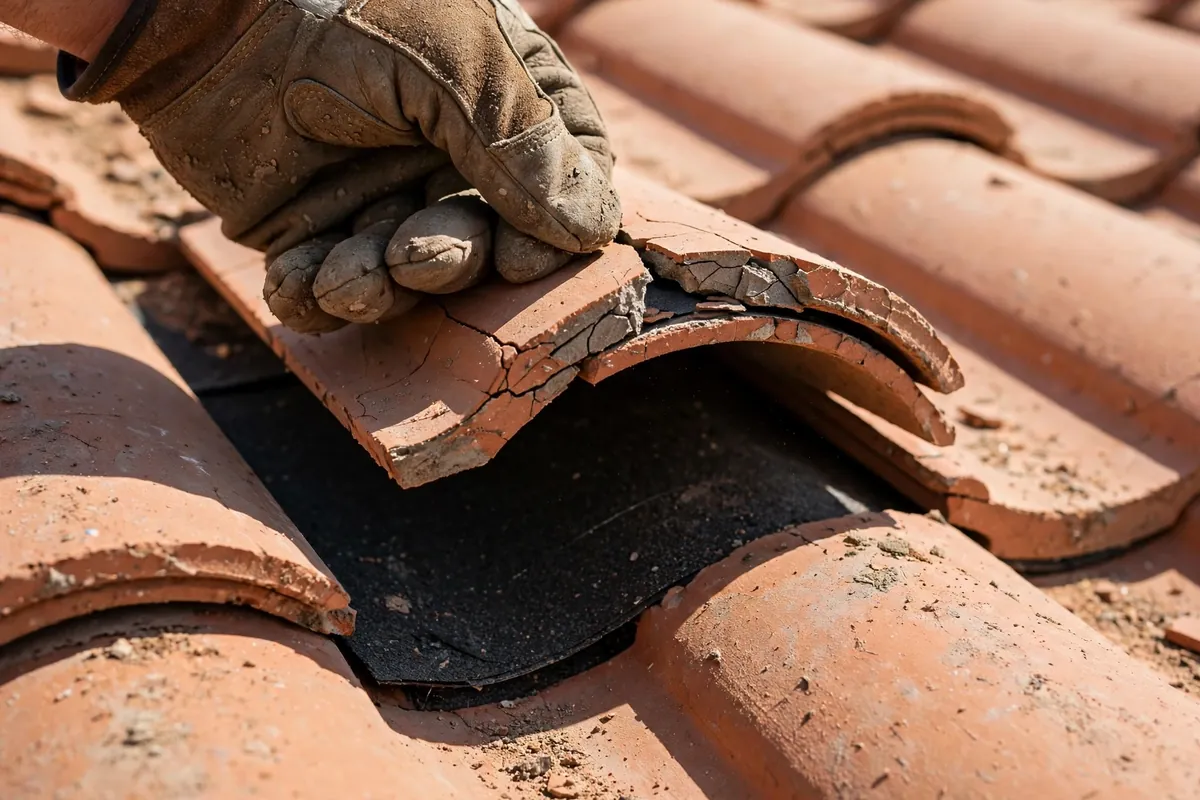
Cracked and broken tiles: a small repair, done the right way
A single cracked tile is the simplest repair on a tile roof — and also the easiest to get wrong. The broken tile has to come out without breaking its neighbours, which means lifting the tiles above it first and sliding the damaged one free. A matching replacement goes in its place, fixed the way the original was, and the surrounding tiles are reset. That is the whole job, and on a roof where the underlayment underneath is still sound, it is a repair that should last as long as the tile around it.
What matters is the match. Concrete and clay tiles come in many profiles and colours, and a tile that does not match sits proud, catches wind and looks wrong from the street. On older roofs the original profile may be discontinued, and a good roofer will know where to find salvage tile — or, if none is available, will place the closest match on the least visible slope and move a salvaged original to the street-facing side. The other thing that matters is what the cracked tile was hiding. When the tile comes off, the underlayment beneath it is visible for the first time in years, and if it is cracked, brittle or crumbling, the honest finding is that the tile was not the only problem. A cracked tile that keeps reappearing in the same place is a sign worth taking seriously: it usually means the same slope is being walked on, or the underlayment beneath that patch has gone.
Slipped tiles, ridge caps and valleys: where water gets in
A slipped tile is easy to spot from the ground: one tile sitting at a different angle from its neighbours, or a dark line where a tile has slid down and left a gap. Wind and thermal movement cause it, and monsoon gusts finish the job. The repair is to lift the tile back into place, check the fixing and the underlayment beneath it, and reset it properly. Left alone, a slipped tile is a leak waiting for the next storm, because the gap it leaves points straight at the underlayment — and the underlayment was never meant to be the roof's only defence.
Ridge and hip caps fail more slowly. The mortar that beds them dries out in the Scottsdale sun, cracks, and lets the caps loosen. You will see it as a ridge line that no longer runs straight, caps that rock when touched, or mortar that has crumbled away and fallen into the gutters. The repair is to re-bed the caps in fresh mortar, sometimes with a flexible sealant, and to replace any cap that has cracked. Valleys and flashing are the quietest problem of all: the metal in a valley collects dust and debris, holds moisture, and corrodes over time, while flashing around a chimney or skylight lifts as sealant ages. Water follows the valley and the flashing first, so a leak that appears near a chimney or in the middle of a ceiling often started at one of these joints. If you are seeing stains and are not sure where they began, our guide to why your roof is leaking walks through the usual sources and what to check first.
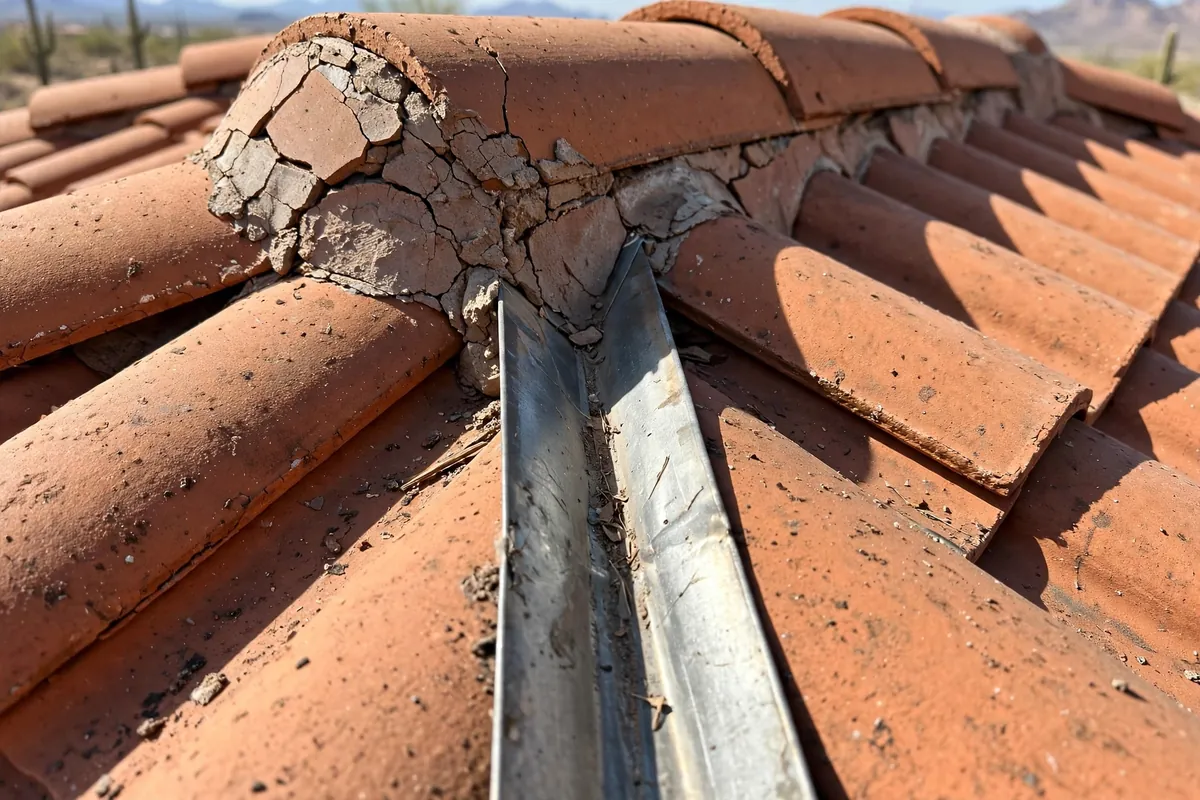
The part you cannot see: underlayment
Here is the fact that surprises most Scottsdale homeowners: a tile roof is not waterproof. The tiles are a shield, not a seal. Rain gets under tiles — through gaps, around fixings, driven by wind — and the layer that catches it and sends it down the slope is the underlayment, a membrane fastened to the wooden deck below the tile. As long as that layer is intact, a little water under the tile is no problem at all. When it fails, nothing above it matters.
In Arizona heat, the underlayment is the short-lived part of the system. The original felt on many Scottsdale homes — built in the 1980s, 1990s and early 2000s — was never designed for decades of 110-degree roof temperatures, and it dries out, gets brittle and crumbles, usually somewhere between 15 and 25 years after installation. The tiles above it can still look perfect. That mismatch is the single most common roofing problem in the Valley, and it is why a roof can look flawless from the street while water runs into the attic every time it rains hard. The signs are easy to miss: stains that appear after heavy rain and fade, a musty smell in the attic, damp insulation, or tiles that keep slipping in the same area. A home built 20 or more years ago with its original underlayment is in the failure window whether or not a leak has shown yet. The lifespans of every roof type, and what wears them out, are set out in our guide to how long a roof lasts in Scottsdale.
What a tile roof lift and relay involves
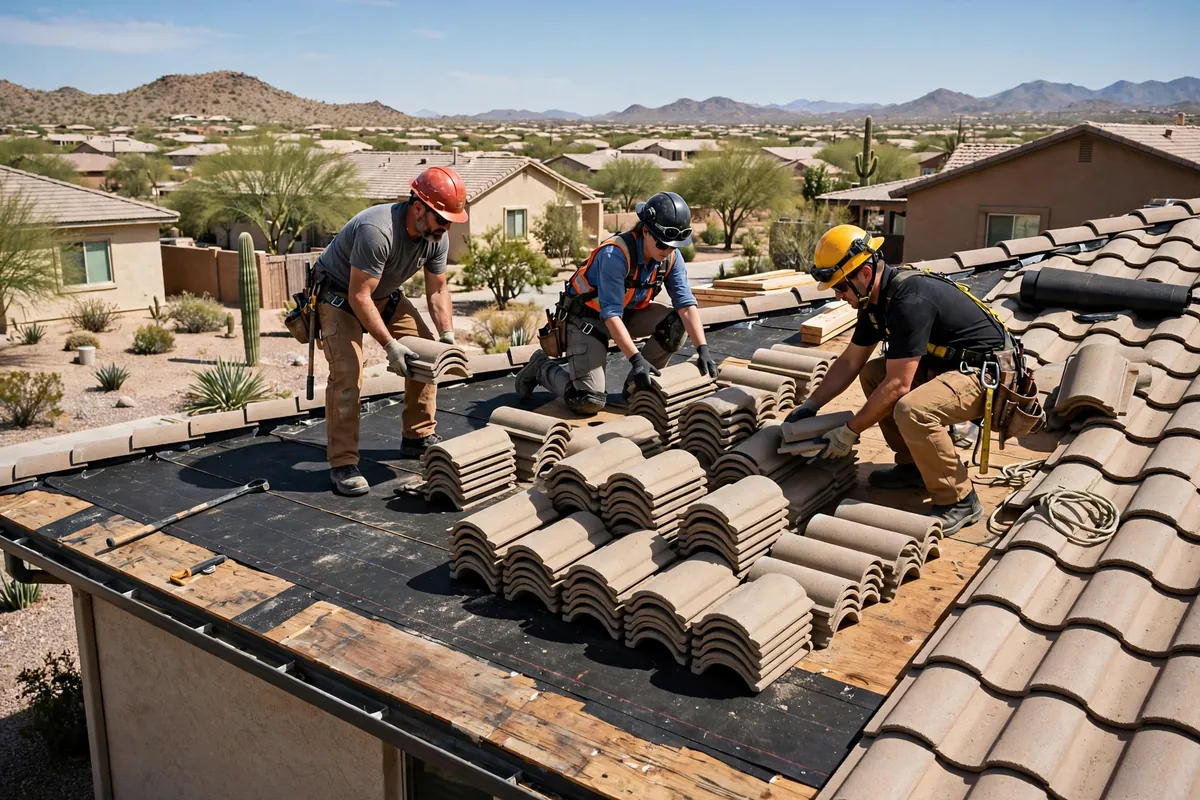
When the underlayment has failed across a slope — or across the whole roof — the correct repair is not a new tile roof. It is a lift and relay: take the tile off, replace what failed underneath, and put the same tile back. It is the standard fix for a tile roof of 15 to 30 years old with sound tile, and it is worth understanding because it is the job most Scottsdale tile roofs will need once in their life.
The work follows a predictable sequence. First, an inspection maps the roof: which slopes have failed underlayment, where the decking is sound, and how much tile is likely to break during removal. Then the crew lifts the tile by hand, course by course, and stacks it on the roof or on the ground, sorting the broken pieces as they go. Handling is where breakage happens, so this is the step that separates a careful crew from a fast one. Next, all the old underlayment and fasteners come off down to the deck — the first time anyone has seen the roof deck in two decades, and the place where surprises live. Any soft or rotted sheathing is replaced, and it should be photographed before it is covered again, because deck repair is the most common place a homeowner can be taken advantage of. Then new underlayment goes down, along with new valley metal, new pipe flashings and new edge metal, and the original tile is relaid with matching replacements filling in for breakage. On a discontinued profile, new tile goes on the least visible slope and salvaged original tile moves to the street-facing elevations, so the roof reads uniform from the ground.
Repair, lift and relay, or replace? How to decide
The decision comes down to how widespread the failure is, and an honest roofer will show you the evidence rather than ask you to take it on trust. A spot repair is the right answer when the problem is local: a handful of cracked tiles, one failed flashing, a short run of slipped tiles, and the rest of the underlayment is still flexible when it is inspected. A partial lift and relay makes sense when one slope or one valley is clearly worse than the rest — south and west facing slopes age fastest in Scottsdale, because they take the most sun — and the rest of the roof still has life in it.
A full lift and relay is the right answer when the underlayment has failed across the whole roof: leaks in several places, stains after every storm, underlayment that crumbles when it is touched. Full replacement — new tile as well as new underlayment — is only needed when the tile itself has failed: widespread cracking, a discontinued profile with heavy breakage and no salvage source, or a homeowner who wants a different look or a lighter material. Our roof replacement in Scottsdale page sets out how that larger job runs, including the permit and HOA steps that come with it. The point is that the cheapest correct answer is usually the smallest job that fixes the layer that actually failed — and the most expensive mistake is paying for a repair on the wrong layer, then paying again when the leak comes back.
What to check before you call
You can learn a lot about your tile roof without climbing on it — and you should not climb on it, because walking a tile roof the wrong way breaks tiles. From the ground, with binoculars, look for tiles sitting at a different angle from their neighbours, a line of tiles that no longer runs straight, cracked or missing tiles, and ridge caps that have shifted. Look at the gutters for pieces of mortar, which mean the ridge bedding is breaking down, and at the flashing around chimneys, vents and skylights for metal that has lifted or rusted.
Inside, the attic tells the rest: stains on the decking, damp insulation, daylight where it should not be, or a musty smell that was not there last year. Write down what you find, with dates and photographs, and note the age of the roof if you know it — a tile roof on a home built 20 or more years ago with its original underlayment deserves a closer look even without a leak. Two other checks matter in Scottsdale. The first is your HOA: many neighbourhoods require architectural approval for visible changes, including a change of tile colour or profile, so the repair should use matching tile wherever possible. The second is the season: the best time to find and fix a tile roof problem is before monsoon season, not during it. A roof inspection in Scottsdale gives you written findings and photographs of the whole roof — including the underlayment's condition, which you cannot judge from the street — and that record is what turns a guess into a decision.
The takeaway: fix the layer that failed
Tile roof repair in Scottsdale works when it starts from the right diagnosis. A cracked tile is usually a small job. A slipped tile or a loose ridge cap is a small job too, if it is caught early. But a leak that keeps coming back, or stains that appear after every storm on a roof that is 20 years old, is usually telling you about the underlayment — the layer you cannot see, and the one that decides whether the roof keeps water out. The good news is that tile roofs are built to be repaired this way: the tiles come off, the failed layer is replaced, and the same tiles go back on for decades more.
If your tile roof is showing any of the signs in this guide — cracked or slipped tiles, crumbling ridge mortar, stains in the attic, or simply an age that puts it in the underlayment window — the next step is a look at the whole roof, not just the one place that leaked. A tile roof that is inspected twice a year, with slipped tiles reset promptly and valleys kept clear, gives its underlayment the easiest possible life, and gives you the longest possible run from the tiles you already own.